
The Copenhagen Sakura Festival is well known for featuring many Japanese cultural performances. Every year, you will experience both traditional and modern Japanese culture through the performances on stage, amidst the blossoming Sakura trees.
For the opening ceremony, the group Sakura Harmony will perform a couple of songs in Japanese. The translation of the lyrics for the songs, can be found by pressing this link or scanning the following QR code.

Here is the program for Copenhagen Sakura Festival 2026:
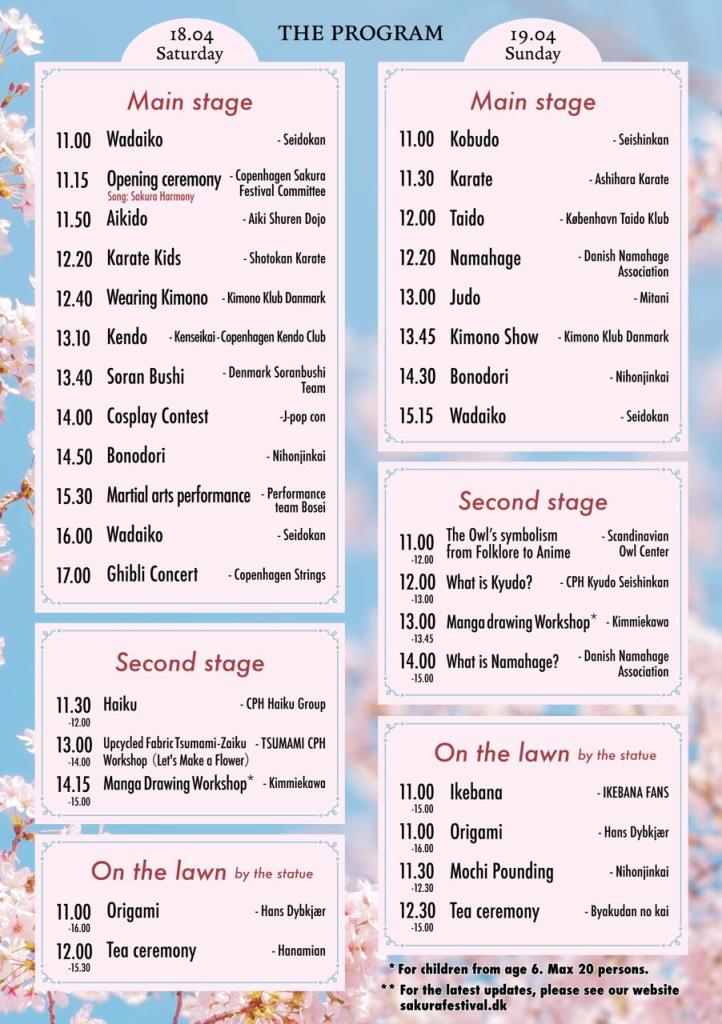
Download the Sakura festival 2026 program
Program explanation
For those who are already interested or invested in Japanese culture, most of the performances might make sense, but for those who are new to Japanese culture, you might want a bit more information. Here is a short overview of the different performances and what they are all about:
- Aikido – Modern Japanese martial arts with “way of harmonizing energy”.
- Bonodori – The famous Japanese group dance that everyone can join!
- Cosplay – A modern type of performance art where the participants dress up as their favorite characters form anime, manga, video games and more.
- Ghibli Concert – The Copenhagen Strings with professional musicians with: 2 violinists 1 bratsch and 1 cello, play famous Ghibli music.
- Haiku – A Japanese poetry form composed of 17 syllables.
- Ikebana – Beautifully crafted traditional Japanese flower arrangements with more than 1000 years of history!
- Judo – A classic, unarmed Japanese Martial Arts form.
- Karate – Famous Japanese martial arts – but it might be different from what you’ve seen on TV!
- Kendo – Actionpacked Japanese sword fighting in a (pretty) safe manner!
- Kimono – A traditional garment that happens to be the national dress of Japan!
- Kobudo – Intense Japanese martial arts featuring traditional weapons and techniques.
- Manga & Anime Drawing Workshop- Manga is the word for graphic novels and Anime is the word for animated works – often versions of already existing manga.
*Please bring your own pencils (HB or 2B recommended) and eraser. For children from 10 years or older. - Mochi & Mochitsuki – Learn about the traditional chewy Mochi ricecakes and watch how it’s made.
- Namahage –Winter traditional folk art, one can see in countryside of North Japan.
- Origami – The Japanese art of folding paper. Watch as a regular piece of paper turns into artworks!
- Soran Bushi –Folk dance which symbolizes the fisherman`s life with energetic dance. The group came from Odense.
- Taido – Taidō is a Japanese martial art.
- Tea Ceremony – Yes, tea is much more than just a drink. It’s tradition, art and cultural activity.
- The Owl’s symbolism – A unique and insightful lecture exploring the symbolism of owls, from ancient folklore to modern anime, accompanied by live owls!
- Tsutsumi-Zaiku- Handcraft, using old kimono silk material and create a new small flower.
- Wadaiko – A high powered drum show featuring the Japanese Taiko drums.
The show is performed by Seido Taiko (DK)
Payment info
At the festival, cash, cards, and MobilePay are accepted. However, please note that payment methods may vary depending on the pavilion.
The nearest ATM is located at Østerport Station.
Waste policy
We kindly ask visitors to take their waste home whenever possible.To support this, we encourage you to bring eco-bags, reusable chopsticks, and reusable cups.
In Japan, even though there are few public trash bins, the streets remain clean.This is because there is a strong culture of taking personal waste home.
We invite everyone to experience and respect this aspect of Japanese culture together. If you need to dispose of waste at the park, please make sure to separate it correctly.
A “Newloop deposit box” for reusable takeaway containers is located next to the information tent. Please return your containers there.


You must be logged in to post a comment.